Showing posts with label ghost school. Show all posts

Sunday, September 27, 2020

Yesterday's School


School

In The Country


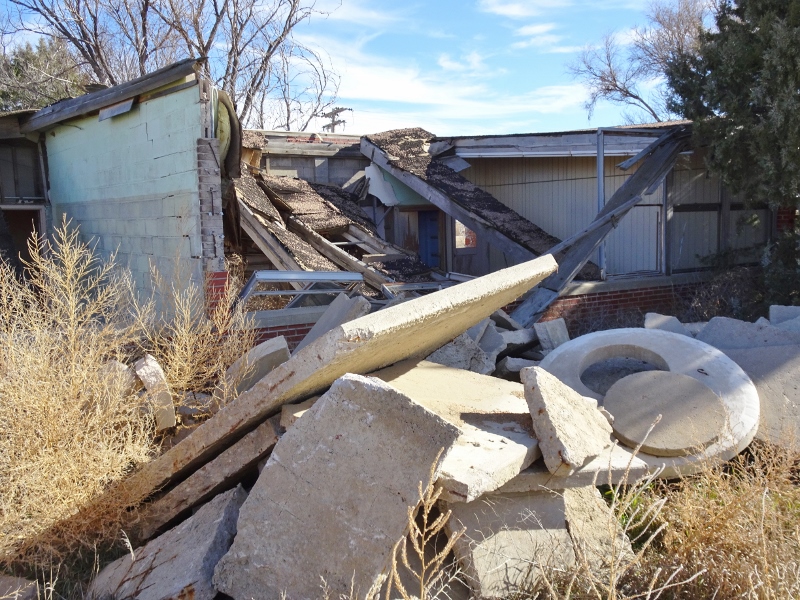
Scattered across the high plains of Colorado are variety of old country schools.  A few have survived and are still sitting on their spot.  Others have moved and have new uses.  This school appears to be sitting on its original spot and worse for wear.  Time and the elements are slowly bringing it back to nature. 


School districts were usually based on a township, 36 sections, one section set aside as school land.  Most school land was pasture land and the monies from its lease went to the school district.  That is probably why the building is still standing, it is not a tax liability.  It was probably built around 1915, plus or minus a few years. 


When it was constructed, there were few more folks in the area then today.  There were usually one family per half section but not all homesteaders made, had to sell out and move on.  That still would have left about 30 families in the district.   At the road intersection there could have been three families at the corner and more within a mile or two. 


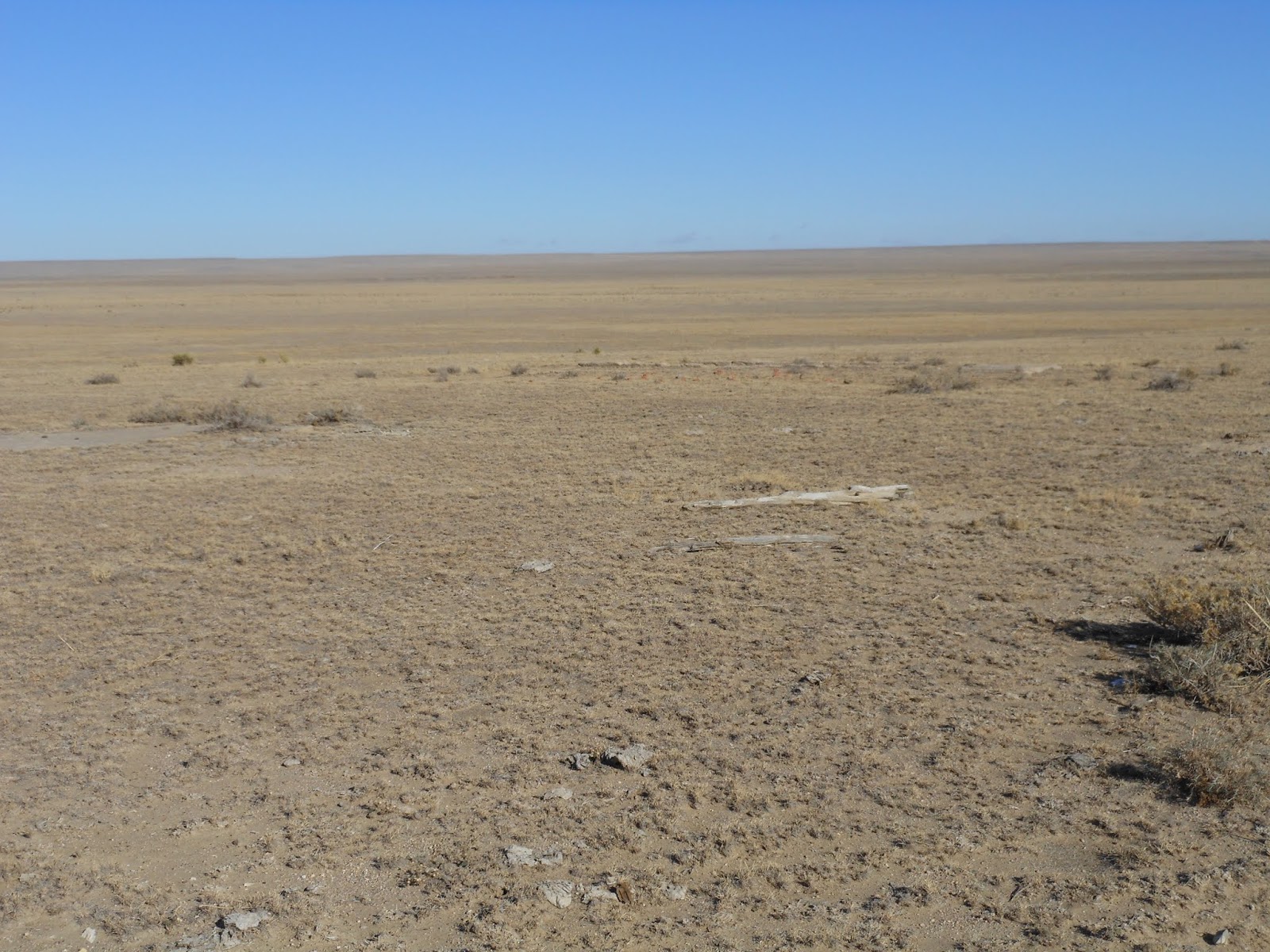
What would of it been like to go to school here, more then a hundred years ago.  There would be no buses back then, so walking was the transport mode.  Maybe ride the horse bareback down to the fence and walk rest of the way.  Listen to the coyotes as you walk along, the distinct odor of the polecat, sidestep the rattler or maybe sing with the birds.   The winter all bundled up, trudge over the prairie, leaning into the wind, books tightly gripped.  There would have been path across the pasture or around the fields.  Look at the background of the picture and take a mile and half walk across the land.


There were no lunchrooms, so lunch was what the kids carried. Using a lard pail or wrapped in a cloth.  Food was homemade, nothing store bought.  There were no thermos bottles back then, so water or kool aid was the drink, often from a canteen. 


Mom and dad probably had not gone to school so homework the parents were learning with their children.  Often story time was one of the youngsters reading for the parents could not.  By the time the first one was in the 6th grade, mom and dad were usually pretty good readers and good at arithmetic.  Sixth grade was the graduation for most boys, a few girls went on to 6th.  The boys were to help dad with the farmwork.  With busses, the children could go into town and finish high school.  Most of the farm boys in WWII had only a sixth grade education. 


Sounds harsh, yet these youngsters survived and went on to be grandparents. 


Sunday, December 16, 2018

Woodrow School


Woodrow Schoolhouse

            The Woodrow schoolhouse is located to the south and west of the town of Woodrow.  A true country school, surrounded by prairie and farmland.  The land is now pretty empty, most of the farmhouse are gone.  There are a couple of farm homes nearby and the home of the folks that bought the old schoolhouse. 
            The building has set neglected for years and shows the wear.  Trees have sprouted up next to the foundation, windows are broken and the roof is crumbling. 
            In the late 40’s, oil was discovered in NE Colorado, the Julesburg Basin, that stretched into southern Washington County.  This oil boom provided some taxes for the local school districts and the folks of Woodrow got together with the people of Lindon.  They agreed to consolidate their schools and a new school was built in the pasture.  Woodrow School would be no more.  It would become a part of Woodlin School. 
            At the time the new Woodlin School was built, it was a state of the art facility.  Best equipment, school labs, classrooms, cafeteria and sports facility.  But the rural population decline did not halt.  The new consolidated school lost students and today it is a country struggle to keep things going.  Yet the country folks do not give up, their school is still their home pride and Woodlin is one of many schools out east that roll along, turning out some of the best students in the state. 
            The old Woodrow school building still stands, for how many more years is a question.  Like a waning beacon it stands on the prairie. 


Saturday, December 1, 2018

Gary School


          Gary was a community situated in the SE corner of Morgan County. The schoolhouse is about the only reminder that there once was a community.  There are no buildings in the area that look like they could have been stores.  The Post Office, more then like;y was operated out of a private residence..
          The schoolhouse has been neglected for years and is overgrown that is has almost disappeared.  The small gym/auditorium sits high enough to be visible. 


          The landscaping out front has gone un tended and has covered over the front of the school.  In the back it is overgrown with weeds and assorted rubble.  The driveway around the school is maintained and appears to used to park equipment on occasion.  The back of the gym had double doors and may have been a garage at one time.  Now it house a fox and other critter. 
          Not a one room school but an interesting school to find and ponder as I walk around it.  Back in the day it was probably a primetime school for the country kids that went to school there.  From the classrooms and size I would guess it schooled 40-60 students, grades one thorough twelve.  Kindergarten was a city thing years ago. 
          The roof has caved in, windows are broken, doors stand ajar and mother nature continues reclamation work. 


Saturday, August 18, 2018

Green Knoll, Colorado


Green Knoll


Green Knoll was a settler’s community.  Located in the southern part of Lincoln County, CO.  It is one of the most sparsely populated areas of Colorado, about one person for every 10 square miles.  During the early 1900’s it was homestead land where one could pursue their dreams. 

When there is moisture in the land, it looks bountiful and productive ground.  Then it forgets to rain and the land becomes parched.  Yet the knoll the school house was located on was green.  The rolling land would stretch out like a green carpet after it rained.  For the early settler it was enticing.


Homes were built, there were families with children.  Times were plentiful, with optima a school was built and a Post Office was located in the farm home across the road.  Then the Dust Bowl struck, dreams were dashed and blown away. 

People fled the land that was no longer productive and today there are a few that hung on still work the land.  The few ranch homes in the area are miles apart.  Yet on the Knoll that was Green, the remains of the school house can be seen and across the road is where the Post Office had been. 

For the few people that venture into the area, consider it lonely.  The few that remain, this is home.  The wide open vacant land that stretches to the horizon is where they make their living.  The rolling pastures are their offices. 


The occasional critter dies and their bleached bones are laid out across the prairie.  Over on far horizon can been seen a windmill.  Sitting in silence, a monument to man to make a living on the land. 

Years ago before the Dirty Thirties, this was the land of hopes and dreams and people traveled out here to live.  Today, people would ask why.   Well one has to understand the conditions the people in Europe were living in at that time. 

So my little pickup goes bouncing down the dusty country road looking for more lost dreams. 


Sunday, November 5, 2017

Joliet, CO


Arlington, Colorado
           
            Arlington, began its life as a railroad camp on the Missouri Pacific RR, in Eastern Colorado.  The trains have stopped running and the rails collect rust.  No longer is there the clicking of wheels flashing over the tracks.  Cars and trucks can be heard rumbling along the highway that followed the rails to Pueblo. 
            There a couple of hardy ranchers that still call this little prairie burg home.  The Post Office closed and moved to Hasewell a few years back.  The roadside businesses are gone and the few store fronts are now silent.  The roadside park has a caretaker and the occasional traveler will stop for a moment.  Silence is the main companion for the few that pause.


            The main feature of the town is the schoolhouse that sits in far corner of the town.  The two story building dominates the land, yet years of neglect is showing.  Number of years ago some locals wanted to buy the school but the scrapper that owned it would not sell.  Today the junk that had littered the yard is gone except the tires left in the weeds.  The winds whistle through broken windows, the bell tower is sliest for the few birds and it appears that the school may be doomed. 

            The town has set vacant for so many years that the weeds dominate.  The few streets are overgrown and the remains of houses and building rise above them.  Street signs mark where the roads had once been.  Rooflines are barely visible in the overgrown town. 
            Yet someday the tracks may hear the clicking of wheels again.  A group wants to buy the rails but the transaction is held up in court and government agencies.  Arlington has no farming, most of that is to the east.  Trains would just pass through the remains of what once was on their way to Pueblo. 

            Nearby is a WWII auxiliary airstrip and little further is Adobe reservoir.  The canals today carry dust of yesteryear when the sugar beet ruled the country.  


Saturday, September 30, 2017

Vernon


Vernon, Colorado
            Located on the north central plains of Eastern Colorado, the little village has more memories on Main Street then pedestrians.  It is a country settler’s village that has hung on.  There are no major highways through town or a railroad.  Yet the town has maintained a small population of around 30 souls.  Main Street is empty, boarded up and the sidewalks are rolled up.  Down at the end of the road is the Post Office, there are enough residents in the area to keep it going. 


            For one weekend a year, Vernon comes to life, people stroll the town park, tractors pop and sputter and horses have the right of way.  Vernon Days is celebrated just before Labor Day.  It is a day to remember when their forefathers came into the area and homesteaded.  The few town folks roll out the old time carpet to celebrate yesteryears. 
            Otherwise the other 51 weekends are pretty noiseless as the sleepy little goes about life.  Surrounded by farmland, the whirr of farm equipment is more common the laughter of school children, from the now shuttered school house.  The little country church is well kept and hears the word on occasion.  The shops of Main Street remind one of when they could stop in and pick up supplies.  Across the street is the town park square, well groomed and cared for.


            Off in the distance on a ridge can be seen the community cemetery.  Looking at it one could see that the area was populous at one time.  Yet like so many prairie towns, the people left to try and find greener fields in the city. 


            Those that remain have different pace of life, the nearest towns with shops are miles away.  Sometimes the bus ride to school can be over 100 miles.  Yet the people take it in stride and live out a life from the land.  


Saturday, June 10, 2017

Schoolhouse

Country School
Edison


            Driving across the plains of eastern Colorado, there is lots of empty land and one can see forever.  Building and trees on the horizon, generally mark farm houses or ranches.   This time the long empty road went past a schoolhouse.  For miles any direction, there were no tows, yet here there was a school complex.  Elementary, middle/jr high and high school and nice auditorium/gym, neatly groomed next to the gravel road in the middle of somewhere. 
            Farms and ranches have consolidated as more and more people leave the land and move to the city.  The few towns left behind, dry up and become memories of earlier days.  So the local families get together and consolidate their school districts into one.  There are still long bus rides, as much as 30-40-50 miles to school.  For some, it is better than a 100mile trip to the big town. 

            Edison school district is way out at the eastern end of El Paso county crossing into Lincoln County.  It is listed as being in Yoder, which is up the road about 15 miles.  Nearby is the town of Truckton and all around is lots of land to farm and ranch. 
            When towns disappear the folks get things worked out to educate their children.  Consolidated districts usually a variety of ghost towns/communities and the school house becomes a reminder of what once used to be.  What’s amazing, is the education in these little schools is just as good as it is in the big city. 
            The students in the country school don’t have the gangs to deal with or the noise of city life.  In the country classes are smaller, giving the students more personal attention.  There are sports programs, music, plays etc.  The school becomes a social center for all types of activities.


            Some homes are hauled in to provide housing for some of the teachers and small town kind of builds up.  Some of the locals will rent out to new teachers.  Sometimes the local are teachers and doing their farm and ranch work in the morning and evenings, through the summer.  The one room schoolhouse has been replaced by a sleek modern schoolhouse.  It has become a ghost town in reverse.  

Sunday, May 14, 2017

Kuhn's Crossing


            One of those places where I was a few days late and a whole bunch short.  Situated off Hwy 94 and down a dead end road a short distance, was Kuhn’s Post Office.  This where one could cross Bijou Creek and continue their journey westward.  Off and on for years I drove past this location, not knowing what was located just over the rise. 

            Back in the trees lining the creek I could see a barn with its silo and the other ranch buildings.  It was a very pastoral scene as I whizzed by on the highway.  Back down the road had been Kuhn’s Crossing Schoolhouse and there were some log cabins. 
            Over the years these structures had weathered and collapsed into piles of lumber scrap heaps.  The markers of the little pioneer community were gone.  Down the road a ways were some ranch houses and outbuildings after crossing the creek.  A rubble heap sat on the ridge where the school had once been.  I took too long to go looking and found not much. 

            It is a fascinating area to drive through.  To the south a ways was a stage stop and a branch of the Smoky Hill Trail.  To the north on another road is another branch of the Smoky Hill Trail.  There are some other communities nearby and some wide open range land.  Cottonwoods line the creek bottoms and stately pines dot the ridges.  It is a varied land of rolling grasslands, towering ridges, 7000-8000 feet in elevation.  The Indians would roam here in the summer

            Today, many of the pine trees have grown back, ranches dot the land and cattle graze the grasses. 
This a picture in the Elbert County museum. 

Saturday, January 21, 2017

Golden Belt Route Part II

Clifford, Colorado
            On the western end of the remains of the Golden Belt Route is the little town of Clifford.  Of the three towns along the roadway, Clifford is the smallest.  There are still a couple of buildings still there, the schoolhouse and the Wards house.  What makes Clifford so interesting are the myths associated with it.  The buried gold treasure, the Indian battles, stage stops and the family that perished riding the train and they were buried at Clifford. 
            Clifford is just south of US 40 and can be seen from the highway if one looks closely.  Rolling down the country road towards the creek, one passes the one room country schoolhouse.  It sits in a pasture, dealing with the elements of time.  It is pretty much like it was over 100years ago.  Out back is the coal house with attached out houses.  Over the years some people have vandalized it, tearing screens off to get in or…. But it hangs in there.

            Going on south one can see the depressions in the pasture where the rest of the town had been.  At the railroad tracks, there are the foundations and footers for the railroad buildings and water tank.  On south of the tracks, behind locked gate in the ranchers pasture, is the mail order house.  Huge rambling building that may have been a rooming house.  The porches have caved in, the windows are gone and with some imagination one can see the ghosts floating around the weather beaten house. 
            The east edge of town is Coon Creek, the Mirage stage station had been here.  The Indians had also used the creek for a sweat lodge.  Through here Coon Creek is a pretty good sized steam, 10-15 feet deep and 20-30 feet across.  Looking to the north, about 6 miles are the grove of trees that mark Coon Springs, a stage stop on the Smoky Hill Trail.  Next to the railroad tracks is the small graveyard.  These three elements make for farfetched stories that probably have basis in fact. 
Looking up Coon Creek
In the distance can be seen the trees of Coon Springs

            The spring of 1864 an Army payroll wagon was robbed by 3 men near Coon Springs.  They were not very successful in their getaway.  The troopers were after them and catching up with them the robbers ducked into a gully.  Here they put the gold coins into dutch ovens and buried the gold, using stones to mark the spot.  They figured they would spend their time in jail, then return and dig up their loot.  One was killed in a gun fight after getting out of jail, another went back to jail after another robbery and the third disappeared.  So the legend of the buried gold grew and people would go out on the gullies looking for the buried treasure.
            Even a gentleman from England traveled to Clifford to search.  He spent over 6 months roaming the area looking for the buried gold.  One day he went to the train depot and very quietly left Clifford with his baggage.  Now if you found the gold, would you shout it from the rooftops or quietly go into the night? 
            When gold was discovered in the Rocky Mountains, the Smoky Hill Trail became a busy place and water on the prairie was important to the gold seekers and other travelers.  Coon Springs became an important stop and this did not set well with the Indians.  Then when the stage stop was established there, the Indians became more enraged and over the decade there were a variety of Indian raids on the station and on the travelers. 
            The spring of 1870 the railroad began building across East Central Colorado.  The Mirage stage station was built along the banks of Coon Creek, upsetting the Indians more.  The spring of 1870, the RR construction crews were building across the plains.  A camp was built near Mirage for the workers and it was a pretty lively place.  That summer the Indians launched a series of raids on the workers and stage stations, from Lake Station to Kit Carson.  Numerous workers were killed and many more wounded and the crews fled back to Kit Carson.  The Indians had stopped RR construction for a short time.  The attacks also brought more army troopers.  General Custer was reinstated and assigned to protect the railroad from Kit Carson to Denver.  The Indians, they turned north and headed to Wyoming to meet up with Custer on another day.
The indention's for the buildings can be seen, in the trees are the concrete remains of railroad stuff and beyond that is the mail order house.  

            With Coon Creek and good water, the railroad built a small station near Mirage and called it Clifford.  Clifford never was a big town, maybe a 100 folks dwelled there.  There was a depot, water facilities and section houses for the RR workers.  Some stores were opened, a saloon and a few homes were built.  Ranchers in the area used for shipping cattle and travel to the neighboring towns. 
            The summer of 1896 a young family was traveling by rail from back east to join her husband in Denver.  Along the way the family had become sick, a mother and two daughters.  By the time they arrived in Clifford, the family had died.  The bodies were taken off the train and left at the train station.  Somebody took the effort to bury them.  A short distance from the depot graves were dug next to the rails and the family was placed in their final resting place.  There were other graves and today it is surrounded by a fence. 
The graves 


            There were the buffalo hunters that would visit.  There were the cowboys and their six shooters and the bar fly’s that traveled through the little town.  And… oh yes…. There are locals who still believe that the gold is still buried somewhere in the area.  


Friday, November 18, 2016

Southeastern Colorado

Edler, Colorado


The old map lists lots of old towns from the late 1800’s to about 1920’s.  There are wagon roads, cattle trails, stage routes and pioneer trails listed on it.  I pack it up with an idea of places I will go looking for.  The trails and roads are hardest to find, those usually involve a lucky per chance.  The little towns and stops are a bit easier in that the map is overlaid on fairly modern road map.  So off I go in search of ……… camera in tow plus other things. 
The Edler well, appears to still be in operation.


Many of the little towns are no more then a farm or ranch house where the Post Office had been located.  The remains of these places are usually a stand of trees and some concrete footers where the buildings once stood.  So when I went searching for Edler, I only expected to find an old house… maybe.  Instead I found the remains of a small village. 

There was a school house, church, some old buildings, water tank and nearby a local farmer had his operation.  I have no idea what the population had been but I would guess it had been around 100 people had lived here.  The Post Office was in operation until 1948 and the school probably lasted longer. 

Edler is in the dust bowl and the dust still blows at times in the area yet there are few who are tenacious and hang on.  Early 1850’s, there was another drought that pushed many more farmers off the land.  The area around Edler reflects that, for it is miles in between neighbors. 

This area of Southeastern Colorado is loaded with little burgs that used to be.  There are canyons with small streams nearby, scrub forests dot the ridges, a sight that does not fit the flat land conception of eastern Colorado.  To the south is an old copper mine, to the northeast was some gold mining.  Edler sits on the flat lands of farmland that is great land to farm when there is moisture. 

It is a land of surprising contrasts that I want to go back to and explore some more of the little villages that are no more.  

Saturday, July 30, 2016

Kansas Ghost

Wheeler, Kansas
            Located in the far Northwestern corner of Kansas, Wheeler is one of those little places that reaches out and grabs the curious like me to go have a look.  Turning off the highway I drove a short distance to where the town of Wheeler used to be and I was pleasantly rewarded.  Here is a collection of old building and relics in various states of neglected decay.  There appears to be about 5 homes still lived in and one of them is the old schoolhouse. 
            The grain elevator is still in operation, which probably keeps the town from completely disappearing.  There are some classic old elevators standing and a feed store.  Probably built around 1900 to 1910. Just enough aura to transfer the imaginative back to another era on the plains of hope and settlement. 


            One of the old store fronts is in pretty good shape, the other in a state of slow crumbling.  Yet in their day they served the townspeople and others in the area that traded there.  There are vacant lots where other stores stood and homes.  There is the main road into town and two little streets, each a block long.  The schoolhouse sits at the intersection of these last two streets. The school had a long veranda/porch added to the front and facing east probably makes nice cool shade during the heat of summer. 


            I went surfing for some info on the town.  Not much was found except that it was founded in the Township of Orlando.  The Post Office was there from 1888 to 1961 and other then that?????  Nothing was found on Orlando except that it was 35.9 square miles and the town of Wheeler was located in the township. 
            Townships were usually used for school boundaries, years ago, for taxation and also for census purposes.  Being unincorporated, Wheeler had zero population but the in 2010, Orlando had 63 souls to be counted for the census. 
            Like many little towns on the prairie, Wheeler had its peak population in 1930, before the ‘Dirty 30’s” began.  The dust storms chased many early settlers out of the country, off to, hopefully, greener pastures.  Few people hung on and the ones that remain today have consolidated much land into their farms and ranches. 
            One of the other interesting things I noticed is the style of different states how they refer to their districts.  Many use county, rather then town and now a township.  Wheeler quite often was referred to as Cheyenne county place in Orlando township. 

            The railroad tracks are still there but it looks like the rails have not seen a train is a few years.  The highway was realigned and the discontinuance of rail service has a major impact on the small prairie towns. 

Thursday, June 23, 2016

Country School

Smoky Hill School

            When one mentions country school, first thing to come to mine is the little one room schoolhouse on the prairie.  Not the Smoky Hill school.  It had been a large two story structure with numerous classrooms for over 100 students.  It is located on the North Fork of the Smoky Hill River, close to the Kansas border. 


            It was prime land for farming and ranching and people flocked to the area during the early 1900’s, late 1800’s.  Collapse of farm prices after WWI chased a lots of people off the land.  Then the dust Bowl rolled over the land, chasing more people off the land.  Yet the country school survived until the 1950’s.  A spring storm boiled up, producing a tornado that tore up school and some of the out buildings. 

            Rather then rebuilding, the students were bused to a nearby town to continue their education.  The school skeleton still stands on the prairie, a reminder of other days.  The building in back is still intact and looks like the tornado did not touch it.  It appears it may have been apartments for some of the teachers.  

Spring on the plains can be a touchy time and terror does strike.  It is one of those things a person learns to live with for there are other moments on the prairie that are beyond compare.