Saturday, August 24, 2019

Home for a Buggy


The Carriage House

            Built in 1890, the structure has withstood the elements for over 125 years.  Over the past decade it has had not TLC and the ravages of nature are showing on the roof.  Unless it gets some care, it will soon beyond repairs.  It does offer me a chance to speculate on how it was used, way back when it was built.
            The home next door was built at the same time and had its beginnings as a hotel.  So that opens lots of possibilities to how it was used.  Next to the old hotel had been another building that may have been a lunchroom/eatery as they were called back then.  It has been torn down and the hotel has been modified so many times it would not be recognized.  The carriage house looks original from way back then, a lean-to on the back has been added. 
            So why a carriage house, being next to a hotel, was this a rent a buggy operation.  Maybe it was a limo service, with the railroad depot close by.  Maybe it was also a taxi service to shuttle the business executives around the county seat.  Whatever it was used for, it leaves lots of memories of another era. 
            When it was built, there would have been no utilities.  Heat would have been a stove, water from the well and outhouse, outback.  There would have been stables to house the horses and feed them.  A stable hand/ driver would have been employed or part of the hotel restaurant operation. 
            For me, it is fascinating to ponder the daily routine of how these people would have went about their daily lives. 
            Above the carriage house can be seen living quarters.  One big room over the buggies.  No electricity, so a lantern or candles would have been used.   No running water, a bucket up the steps with a basin and trot out to the privy.  Heat would have been a coal stove, being in a railroad town.  Cold winters, hot summers, yet at the time it had all the modern comforts of the time.  Kitchen would have been the eatery a couple doors down.
            For the worker back then, living in a carriage house was probably a luxury.   Drive around town with horse n buggy was a status few enjoyed.  Few folks could afford a horse and usually did not have a place to keep it.   So walking to and from work was the norm.   Wonder what the life of a carriage boy would have been like in a small RR town.
            Hugo, Colorado is a small town that was built by the railroad in 1870.   Hugo eventually became the county seat for Lincoln County, formed out of a variety of other counties.  With the railroad as a main employer, Hugo thrived and ranching, Cattle and sheep, business grew to help support the growing town. 


            One of the first Harvey House lunchrooms was in Hugo.   Located in a local hotel, close the first roundhouse and near the depot.  The Harvey House and hotel lasted through the 1890’s.  With railroad changes, Hugo lost lots of residents and businesses but it managed to survive. 
            Besides the town surviving, many of its homes survived from the 1870’s and many are still lived in as homes.  It is fascinating to drive around the town and there are these little homes folks still living in them.  The Dickinson House was restored a few years back, built in 1872.  It is still a private residence.  The town museum is in a residence that was donated to the town, built 1877.  The oldest house in town was constructed in 1870 and is in serious decay.  The new owner will probably tear it down rather then trying to restore it. 

            So a carriage House from 1890 is kind of old, but kind of modern compared to other buildings in the town.  The only sad part is, the Harvey House is gone as is the old RR hotels.  Oh, Hugo does have a Boot Hill.  It is in a pasture north of town.  

Wednesday, August 7, 2019

The Bull that Could


Barnyard Memories
County Fair

One a year the Fair is the end of summer or the beginning of fall.  The projects from the year are put up for judging and viewing.  It is also a time for friends from around the county to renew their friendships. 
Then, there is the carnival and rodeo, the added bonus of the fair.  My father and uncle had a livestock hauling business and usually got the contract to haul the rodeo livestock in to town.  They would help work the animals and keep the rodeo moving along.  It was neat to sit in the bleachers and watch them prod and cajole the critters through their paces. 
For the most part the animals behaved pretty good.  Oh there was always a calf or two that wanted to go over there.  There was the bronco that had a two buck routine then would stop stiff legged and buck no more.  For the most part, things went smooth, steers ran, wrestlers jumped and riders found that the arena floor was not padded.
The bulls were at the end and when that portion came round, the tension rose some.  Could hear them kicking a bawling in the chutes.  The cowboys standing over them trying to get situated just right and out the gate the bull would come with a roar.  Clods flying, spinning bull, rider plowing the dirt, whistle blows and the bull gets rounded up.
There was one ole Brahma bull that wanted nothing to do with the rodeo rider.  Quick turn, high buck and the bull was sending the rider towards the fence.  Doubt it lasted 2 seconds.  The Brahma threw the belt and went for a joy ride across the arena.  The arena workers could not get him turned towards the pens.  Bull on a mission headed for the northeast corner of the arena. 
There the bull met the fence.  Dazed the bull backed up, jumped up, trying to crawl over the fence.   The cowboys were there, waving and hollering but the bull just kept kicking and bucking, slowly working his way up the fence.  The folks in the grandstand were excited and lots of oohs and ahhs were drifting overhead.  
Bull managed to get over the fence and into the runway.  The next fence was but another obstacle for the bull.  Leaping up, he got on the top railing and with some kicking.  The bull on the loose was climbing the second fence.  The cowboys all the time, hollering and waving at him with ropes etc.  The bull was not to be deterred.  It was like he had a girlfriend over yonder he hadn’t seen in a long time.
Across the race track ole bull galloped, coming to the grandstand fence at the southeast corner.   By then folks in the seats were scrambling and looking for safe spots.  The track fence only slowed the bull down long enough for the cowboys to get around the grandstand and try to stop the bull.
Up and over the rack track fence the bull scrambled.   Folks in the grandstand were scrambling also.  There were screeches, screams and lots of hollering.  The escaping bull paid no attention the commotion.  Straight ahead was the carnival and midway.   Folks on the midway and on the rides had heard the racket and when they saw the Brahma headed their way, the volume of hollering went roof. 
Bull saw an opening between the midway and the rides.  Head lowered, he went charging for the carny.  People running hither and yon, the barkers had ducked down in their trailers.   The rides had stopped, stranding riders.  Folks were running any direction they could.  The bull bound through the opening between the rides and the midway. 
Out into the parking he loped.   Cowboys running behind trying to get him stopped.  Some riders had made it out the parking but the bull was ignoring them.  Over there was another fence and beyond was the freedom of a pasture.  The barb wire fence was no challenge for the bull.  Up and over he went.  As he headed to the north, my uncle’s voice yelled out,” Let him go. That is my pasture, We’ll get him the morning.”
The chasers, with a collective sigh of relief, stopped and watched the bull bounce over the ridge.  With the ruckus over, they had to go back to arena and finish the rodeo.  There were still a couple of bull riders waiting their turn.  Folks in the grandstand had gotten back to their seats.  The crowd was still abuzz and there was anticipation with the next couple of bulls. 
The bulls came charging out the chutes, the crowd cheering, wanting to see another escape.  The bulls were not obliging.  Their riders were tossed without dignity to the ground and back to the bullpen they went. 
Next morning my uncle goes riding out across his pasture looking for the wayward bovine.  Couple of guys were with him and by the water tank the escapee lounged.  They got him up and headed him the right direction.  The wayward bull trotted along like nothing was wrong. 
They get him to the gate and headed for the pens at the end of arena.  Placidly the rampaging bull sauntered along into the pen.  That afternoon the bull stood by himself in the pen watching the on goings in the arena.  Folks in the grandstand were talking and pointing but the bull was left alone. 
When the bull riding statured, there were some cat calls to get the wayward bull out and ride him.   An encore of the rampaging bull did not happen.   That evening he was loaded up and sent home with the rest of his friends. 

Saturday, February 9, 2019

Punkin Center


Punkin Center, Colorado
Punkin Center is one of those wide spots where two highways cross, SH 71 and 94.  Here at the junction, there used to be the gas station, restaurant, store, and garage.  The state highway dept. also has a district shop at the junction.  Years ago, the intersection was a busy place.  Cars would stop for fuel and the cafĂ© stayed busy. 
The fella that ran the gas station was a true westerner.  He carried a side arm on his hip and more then once, the presence of the pistol thwarted a robbery.  Late 1940’s, the proprietor was not so successful. 
Couple young joy riders stopped for gas and overpowered the owner.  In the ensuing scuffle the owner of the gas station was killed during the robbery.
The county Sheriff, investigated, gathered evidence, went back to his office.  Making calls to adjoin counties and asking about incidents in their areas, The local sheriff was able to garner some leads.  After a year and half of investigation, the Sheriff gained enough evidence and information to arrest a couple from the valley down south.
Two young men were out joy riding and they decided they were going to stop at the gas station, fill up, then rob the owner.  During the robbery, they also killed the attendant.  Which resulted in a lifetime visit at the Canon City Hotel.
Today, Punkin Center is pretty quiet, the traffic passes through the junction.  The north/south flying through.  The east/west, pausing to salute the stop sign.  The highway dept still has their district shop there and a few folks still call Punkin Center home.


Punkin Center is the home of the World Championship Garden Tractor Pulling.  Through the summer, the garden tractors take center stage.  There is a pulling course and the garden tractors roar down the track. 


Saturday, December 29, 2018

Rago Colo


Rago, Colorado

Rago was a small community in the NW part of Washington County, next to the Morgan County line.  It had a Post Office, shops, stores and a roller skating ring.  The skating rink was an unusual amenity in these small settlement communities on the prairie.   Scattered across the land are other communities with roller rings.
There is not much left of the little burg.  There are some trees that mark the spot and out in the pasture are the rubble piles and foundations where the stores and homes had been.  Today cattle graze among the ruins, listening to the whispering winds of the past. 
It is mostly range land in the area and there are a couple of ranches nearby and some old, falling apart buildings.  The windswept land had its horrible moments during the dirty thirties.  Reminders of the Dust Bowl can be seen on occasion.  One ponders the hardships the early day settlers had to deal with. 
A roller rink would be a good diversion.  It probably also the social center for the area.  Many a young couple met and romance flourished on the hard boards.  The rink was probably also used as a community center.  Meet and discuss the problems of the day, quilting Bee’s, card parties and the weekend hoe down.
One can sit on the empty country road and hear the voices of the past.  Let the imagination roll back to a time that has passed.  Today it seems like hard times.  Back then it was life and people rolled with it.  There was no big government, people made their own way.  This is the heritage our forefathers handed off to us. 
A song of the land that rolled all the way across and ocean and traveled westward.  A spirit that was undaunted by the land.  The land held dreams of their own piece. 


Sunday, December 16, 2018

Woodrow School


Woodrow Schoolhouse

            The Woodrow schoolhouse is located to the south and west of the town of Woodrow.  A true country school, surrounded by prairie and farmland.  The land is now pretty empty, most of the farmhouse are gone.  There are a couple of farm homes nearby and the home of the folks that bought the old schoolhouse. 
            The building has set neglected for years and shows the wear.  Trees have sprouted up next to the foundation, windows are broken and the roof is crumbling. 
            In the late 40’s, oil was discovered in NE Colorado, the Julesburg Basin, that stretched into southern Washington County.  This oil boom provided some taxes for the local school districts and the folks of Woodrow got together with the people of Lindon.  They agreed to consolidate their schools and a new school was built in the pasture.  Woodrow School would be no more.  It would become a part of Woodlin School. 
            At the time the new Woodlin School was built, it was a state of the art facility.  Best equipment, school labs, classrooms, cafeteria and sports facility.  But the rural population decline did not halt.  The new consolidated school lost students and today it is a country struggle to keep things going.  Yet the country folks do not give up, their school is still their home pride and Woodlin is one of many schools out east that roll along, turning out some of the best students in the state. 
            The old Woodrow school building still stands, for how many more years is a question.  Like a waning beacon it stands on the prairie. 


Sunday, December 9, 2018

Community of Flat Top


Flat Top, Colorado

The community of Flat Top was located near the four corners of Lincoln, Arapahoe, Elbert and Washington counties meet.  Situated at the base of the mountain that it took its name from, it was a Post Office, General Store combination.  The first Flat Top Post Office was located in a ranch house about 4 miles north.  With the opening of the store the PO was moved. 
Way back in the early 1900’s there was a good collection of homesteaders in the area to support the little sore and the other businesses that popped up.  Like so many little communities on the High Plains, the Dust Bowl blew many off their land and today it is pretty empty country. 
Today there are a few ranches in the area and the bovines keep the prairie grass mown.  Traffic on the highway flies past going down hill and the south bounders begin climbing up the hill.  On the high plains the 7500 foot hill is just a big hill, not a small mountain.  Because over that a way are the snow capped peaks of the Rockies.  The big mound of dirt called Flat Top is just that, a big hill, an elevation of around 6000 feet.


To the south was the Railroad and many of the local farmers went to Genoa, rather then going over the hill to Limon.  Going around the hill was easier then going over it.  One of the farmers, when he hauled his grain to town, would stop and fill up with coal for the home trip.  That winter he had coal to sell to his neighbors. 
Short distance away was Walks Camp and the Churches that many attended.  To the West were the Breaks.  Here were cool woods, small streams and plentiful wildlife.  The site of many summer family outings.  It was also the hiding grounds of a small band of Indians that did not want to go the Reservation.  By estimates, they were able to avoid the government until WWII. 
It was a land of many faces that held a great allure until the drought of the 30’s reared its ugly head.  Many did cling to their land and survived the dust storms and today their ancestors still live in the area working the land. 

The old highway winds across the face of the hill.  

Saturday, December 1, 2018

Gary School


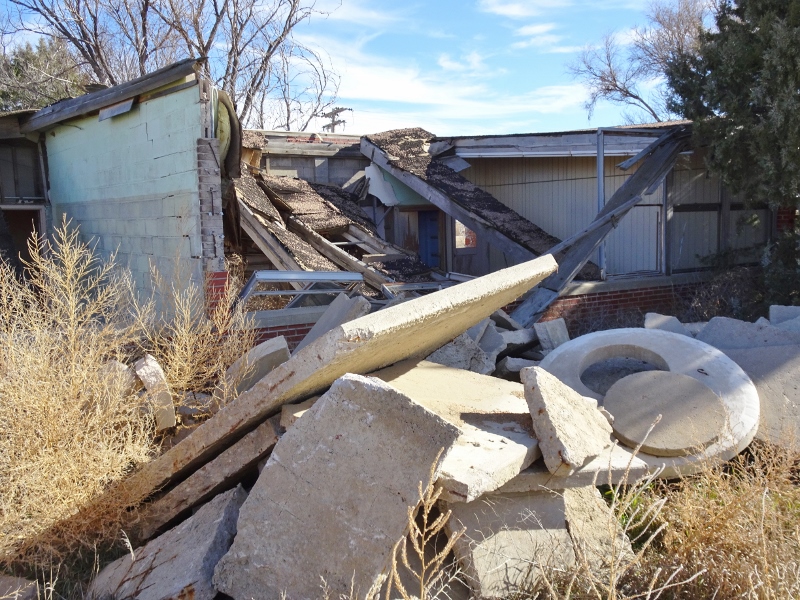
          Gary was a community situated in the SE corner of Morgan County. The schoolhouse is about the only reminder that there once was a community.  There are no buildings in the area that look like they could have been stores.  The Post Office, more then like;y was operated out of a private residence..
          The schoolhouse has been neglected for years and is overgrown that is has almost disappeared.  The small gym/auditorium sits high enough to be visible. 


          The landscaping out front has gone un tended and has covered over the front of the school.  In the back it is overgrown with weeds and assorted rubble.  The driveway around the school is maintained and appears to used to park equipment on occasion.  The back of the gym had double doors and may have been a garage at one time.  Now it house a fox and other critter. 
          Not a one room school but an interesting school to find and ponder as I walk around it.  Back in the day it was probably a primetime school for the country kids that went to school there.  From the classrooms and size I would guess it schooled 40-60 students, grades one thorough twelve.  Kindergarten was a city thing years ago. 
          The roof has caved in, windows are broken, doors stand ajar and mother nature continues reclamation work.